
Supermarket competition in New Zealand: $25m plan for 20-plus stores and up to 1,000 jobs
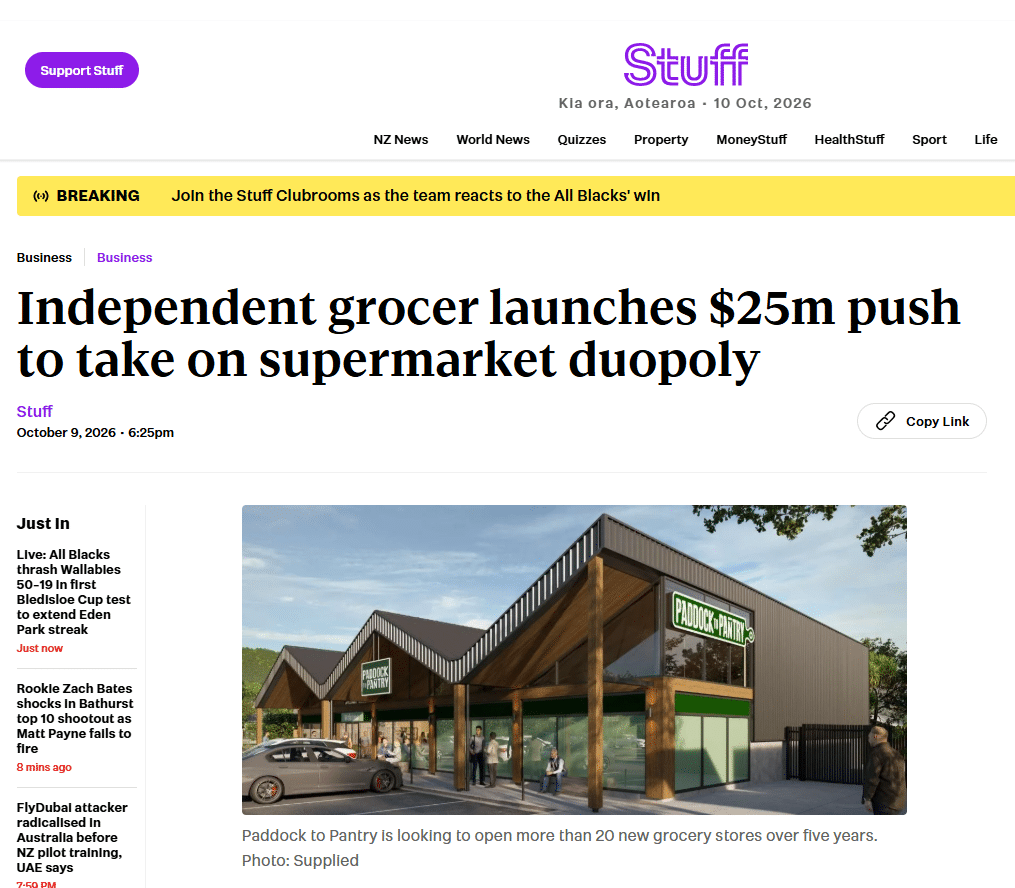
An independent grocery retailer has unveiled a $25 million plan to open more than 20 stores over five years and create up to 1,000 jobs, in a bid to increase supermarket competition in New Zealand.
Paddock to Pantry wants to extend its business beyond online shopping into a nationwide store network, beginning in Kinloch near Taupō in December 2026. It is also proposing a Government-backed fund offering low-interest loans to help established independent grocery operators expand more quickly.
The retailer’s expansion plans have been covered by Stuff. The business says its long-term ambition is to become the country’s third-largest grocery retailer and provide an alternative to the two dominant supermarket groups.

First new store planned for Kinloch in December
The first opening is planned as a 500sqm grocery store in Kinloch, with further sites targeted for the North Island’s East Coast and South Auckland during the first quarter of 2027. The company intends to open approximately one new location every three months.
Its existing physical stores are in Karaka and Kahawai Point, Glenbrook. Completing the proposed rollout would take the network to more than 22 locations, with a focus on regional communities and urban suburbs where supermarket choice is limited.
Potential premises range from 500sqm to 1,800sqm. Larger stores are expected to employ about 50 people each, with additional work anticipated in warehousing, deliveries and distribution as the network expands. The projected figure of up to 1,000 jobs depends on the rollout proceeding as planned.
The retailer intends to offer the same promotional grocery pricing at its different locations, rather than charging according to how much supermarket competition exists in a particular area. It believes that approach could strengthen supermarket competition in New Zealand, particularly in communities with fewer shopping options.
Paddock to Pantry business manager John Kennerley says the expansion is intended to establish a full-scale grocery alternative, not simply a collection of specialty shops.
“We’re not building a handful of specialty food stores. Our ambition is to become New Zealand’s third-largest grocery retailer and provide a genuine alternative to the two dominant supermarket groups.”
Distribution centre and delivery fleet form part of investment
About $10 million of the five-year programme is earmarked for new retail premises. The wider plans include a proposed 5,000sqm distribution centre and an increase in the company’s delivery fleet to 25 vehicles.
The new facility is intended to serve both its planned supermarkets and its nationwide online grocery business. The company expects online orders, which accounted for about 90% of sales when the plans were announced, to represent around one-third within five years as physical stores take a larger share.
Expansion follows a period of rapid growth. Paddock to Pantry reports that sales rose 197% in the 12 months to 31 July 2026 from an existing multimillion-dollar base. It says it handles thousands of orders each day, stocks more than 2,000 products and buys more than 99% of its goods by value directly from manufacturers.
Kennerley says wholesale grocery reforms helped the company achieve sufficient purchasing volumes to negotiate directly with major suppliers. He believes those relationships, together with its existing distribution operations, put it in a position to add physical stores.
“We’ve already done much of the heavy lifting. We have the distribution infrastructure in place, direct relationships with the major grocery manufacturers and a pricing model that allows us to compete.”
Small outlets could combine everyday groceries with prepared food and foodservice offerings adapted to local demand, while larger sites would follow a more conventional supermarket format. The company also points to improved road links between Auckland, Hamilton and Taupō as a factor making distribution across a wider area more practical.
Call for low-interest loans to accelerate grocery expansion
Alongside the store announcement, Paddock to Pantry is calling for a Supermarket Growth Fund that would provide commercially assessed, repayable loans to privately owned grocery retailers with established operations and credible growth plans.
The proposal comes amid continuing scrutiny of supermarket competition in New Zealand. In its June 2026 assessment of the grocery market, the Commerce Commission reported that the major supermarket operators still held more than 80% of national retail market share, although regulatory changes were making entry and expansion easier for competitors.
Kennerley says independent retailers lack the financial resources of the established groups, even when they have supplier contracts, logistics and retail sites available. He argues that finance for store fit-outs, initial stock and recruitment is now a major constraint on growth.
“We’re not asking the Government to fund the creation of a new supermarket business.”
He believes access to low-interest borrowing could allow businesses such as Paddock to Pantry to double or potentially triple their rollout rates. That is a forecast contingent on funding being available, rather than an approved or funded expansion commitment.
“We don’t necessarily need another major overhaul of supermarket competition policy. The existing settings are starting to work, but it takes time for independent competitors to build scale.”
His proposal would leave store ownership and operation with private companies, while government lending would aim to bring forward investment that businesses might otherwise have to fund gradually. No establishment of such a fund has been announced.
Regional jobs and more grocery choices
Kennerley says new outlets would generate demand for retail staff, commercial premises and transport services alongside additional shopping options. He argues that stronger supermarket competition in New Zealand could come from businesses already operating in the market rather than waiting for an overseas chain to build a network from scratch.
“Every new supermarket represents local employment, investment in commercial property and additional demand for transport and distribution services, as well as greater choice for consumers.”
For now, the Kinloch opening is the first scheduled step. The remaining sites, additional jobs and proposed distribution investment form part of the retailer’s five-year plans.
Impact PR and grocery sector communications
Developments in supermarket competition in New Zealand are relevant to retailers, suppliers, property owners and consumers. Clear communications can help grocery businesses explain store openings, investment programmes and the differences between proposed and confirmed developments. Media relations can also give regional communities accurate information about employment opportunities and new shopping options. For expanding retailers, a consistent approach to public announcements supports reputation management and relationships with commercial stakeholders. Impact PR provides strategic corporate communications support for businesses communicating growth, operational changes and industry issues.