
Coconut Water Exporter CocoCoast Targets A$200m as US Tariffs Create Openings
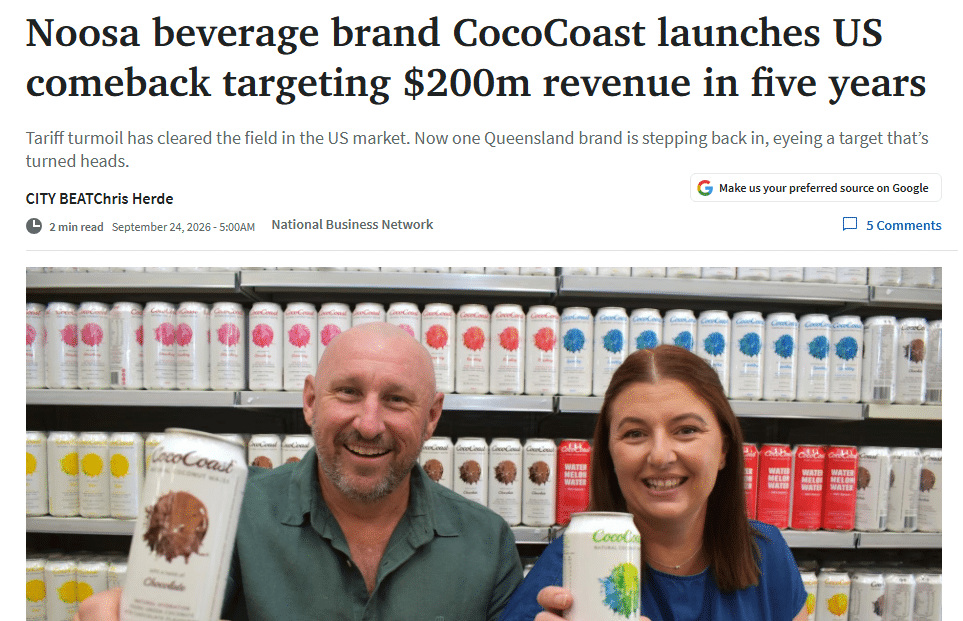
Australian coconut water business CocoCoast is aiming to increase annual revenue to A$200 million within five years, following 53% growth over the past year and reports that US import tariffs have prompted rival overseas brands to retreat from parts of the American market.
The coconut water producer, whose international expansion has featured in The Courier-Mail, currently generates about A$25 million in revenue annually. The company describes its range as the world’s largest selection of coconut water products. It sells approximately 50 million cans, equivalent to 25 million litres, across 20 markets in Europe and the Asia-Pacific each year.
After suspending its US push for 18 months because of uncertainty over import duties and the final cost of getting products into the country, the company has appointed a distributor based in Seattle to lead a measured return.

US tariff uncertainty opens gaps for imported beverages
Co-founder Damian Russell says distributors have reported reduced competition in some outlets as imported drinks companies either curtail American distribution or leave the market. For CocoCoast, the change has created an opportunity to restart sales without committing immediately to a nationwide rollout.
“The challenge in the US wasn’t demand but the uncertainty around what a shipment was ultimately going to cost when it landed.”
Russell says the complexity extends beyond duties on finished drinks. The country of manufacture and the origins of ingredients, cans and other packaging can affect the eventual landed cost, complicating negotiations with importers and retailers.
The first stage will concentrate on Washington and Oregon. The new distributor has purchased two shipping containers and the business is targeting around US$500,000 in sales during its first year back in the US.
It also intends to begin selling through Amazon US within six months of its first shipments arriving, allowing customers elsewhere in the country to buy the products before physical distribution expands.
About 600 American coconut water consumers have registered their interest in being told when CocoCoast is available again. Russell says that existing following gives the business an initial customer base on which to build repeat sales.
“We still receive messages from people asking when they can buy CocoCoast in the US again, so we are not rebuilding the market from a standing start.”
Canada remains a possible market as trade patterns shift
The company is also monitoring the disruption to trade between the US and Canada, although it has no Canadian distribution deal or market-entry programme under way.
Russell says tariff-related price changes could encourage Canadian distributors and retailers to diversify their suppliers. Any move into the country would depend on securing workable distribution arrangements and sound commercial returns rather than simply taking advantage of a short-term opening.
The selective approach reflects the company’s decision to avoid the US market when its import costs were too difficult to predict, despite continuing customer interest.
UK and Europe targeted for A$60m in annual revenue
Beyond North America, the coconut water producer is seeking A$60 million in annual sales from the UK and Europe within five years, or about 30% of its global revenue target. It also wants its products stocked in more than 7,500 retail outlets across those markets over the same period.
The company has signed additional international distribution agreements and says its beverages are now being supplied to the World Health Organization. Its wider network already spans European and Asia-Pacific markets, with further growth planned through new and existing partners.
In Britain, an Amazon launch for its coconut water range is planned in the coming weeks. The business intends to use online, specialist and independent retailers to establish sales records before negotiating broader supermarket and retail distribution, following the approach it used in Australia.
“Our five-year ambition is to reach A$200 million. That is a substantial increase from where we are today, but the biggest opportunities available to us now are in markets many times larger than Australia.”
Russell says Australia has provided more than a decade of experience in developing the range, while several European countries offer the prospect of entering the coconut water category at an earlier point in its development.
Global coconut water market forecast to reach US$19.3bn
The expansion ambitions coincide with forecasts of strong international demand. Grand View Research estimates the worldwide market was worth US$5.1 billion in 2025 and predicts it will reach US$19.3 billion by 2033, with average annual growth of 18.2% between 2026 and 2033.
Its projections put annual growth for Europe’s coconut water market at 20.2%, making the region a particular focus for companies seeking to establish brands as consumer demand develops. CocoCoast’s reported 53% annual growth is above both forecast category rates.
“Coconut water has become a mainstream category in Australia, whereas in a number of European markets it is still emerging.”
Russell says sales performance, repeat buying and profitability will matter more than the number of countries where the products appear.
“We will measure success by repeat purchase, rate of sale and profitable market depth.”
Public relations for beverage exporters
Overseas expansion presents beverage businesses with communication challenges alongside questions of pricing and distribution. Retailers, investors and prospective distributors need clear information about a company’s market position, growth plans and evidence of consumer demand. Relevant media relations can explain international trade developments and new retail partnerships to audiences beyond an existing customer base. Impact PR supports businesses through corporate media relations and strategic communications. Carefully sourced business reporting can increase awareness while avoiding unsupported claims about future sales or market leadership. For exporters operating across different markets, consistency and accuracy in public statements are especially important when tariffs and commercial forecasts are changing.