Demand for commercial shelving NZ grocers use fuels $20m growth plan
A New Zealand commercial storage supplier is targeting $20 million in additional annual recurring revenue over the next four to five years as neighbourhood grocery stores expand their product ranges and retailers invest in larger distribution facilities.
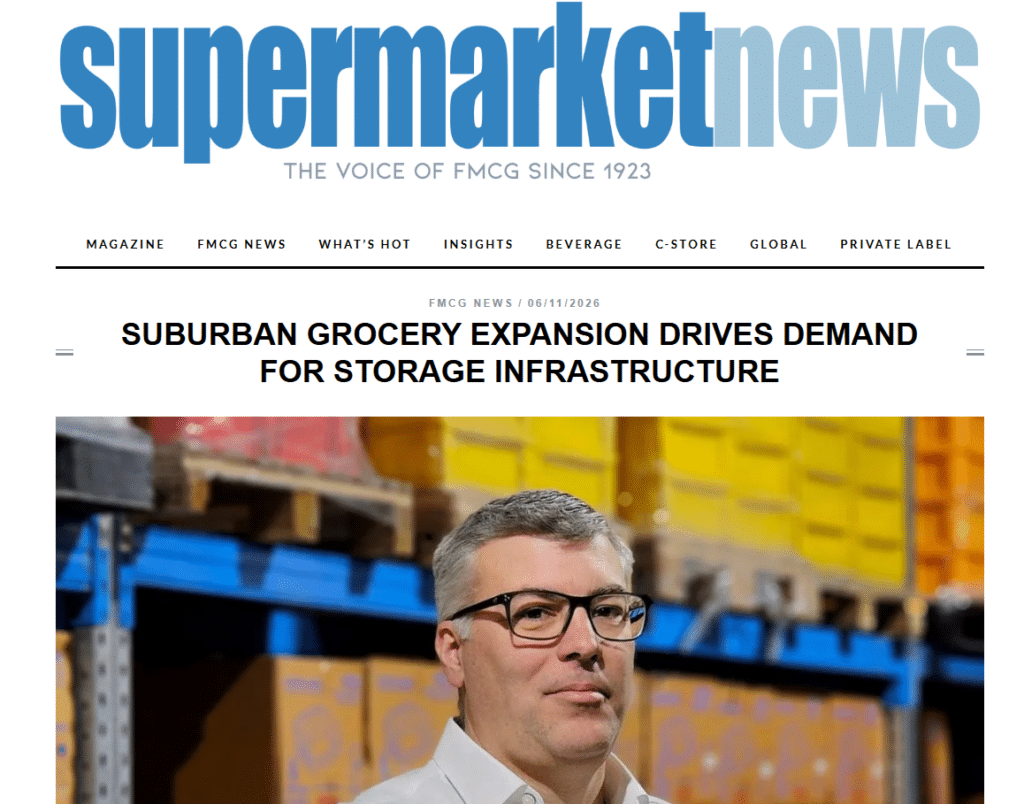
Volume, whose expansion plans were covered by Supermarket News, expects rising demand for the commercial shelving NZ retailers use in stores and warehouses to help more than double its existing revenue.
The company outlined its growth plans in November 2026 following a series of acquisitions that have expanded its engineering and manufacturing capabilities. It is pursuing larger contracts across grocery retail, logistics and healthcare.
Should installation volumes rise in line with its growth plans, Volume could install more than 650km of shelving and racking over five years, roughly equivalent to the distance between Auckland and Wellington.
The Commerce Commission’s 2025 Annual Grocery Report, published on 2 June 2026, identifies a widening range of grocery products being sold through smaller and specialist retailers, as well as the growing role of businesses outside traditional food retailing.
Volume general manager Scott Currie says the changing requirements for commercial shelving NZ businesses install are increasing the scale of contracts, with some individual projects reaching seven figures.
“Ultimately, what is happening in our industry starts with changes in the way people shop. FMCG industry data shows shoppers now visit an average of 5.3 times a week across 3.5 retail brands, moving between supermarkets, specialist retailers and other channels.
“Retailers are responding by carrying larger ranges and changing their store formats. That means more individual products have to be displayed in stores and more inventory has to be held and moved behind them.”
Volume is targeting further growth as New Zealand grocery retailers expand their product ranges and commercial storage requirements.
Neighbourhood grocery stores take on supermarket role
One of Volume’s recent Four Square projects involved a store where the number of product lines available to shoppers rose from about 2,000 to 5,000.
The broader ranges at neighbourhood grocery stores increasingly include fresh and prepared foods once more commonly associated with full-service supermarkets.
Currie says the shift is changing the type of commercial shelving NZ neighbourhood grocers need, particularly when a substantial increase in product range must be accommodated within an existing building.
“For many New Zealanders, a Four Square was traditionally somewhere you stopped for milk, bread and a relatively small number of essentials.
“What we are increasingly seeing is something much closer to a mini-supermarket, where consumers expect to find a substantially wider range of products closer to home.
“If you more than double the number of products being offered without more than doubling the building, every part of the store has to work harder.”
Retailers must also accommodate additional stock without making aisles difficult to navigate or compromising the presentation of merchandise.
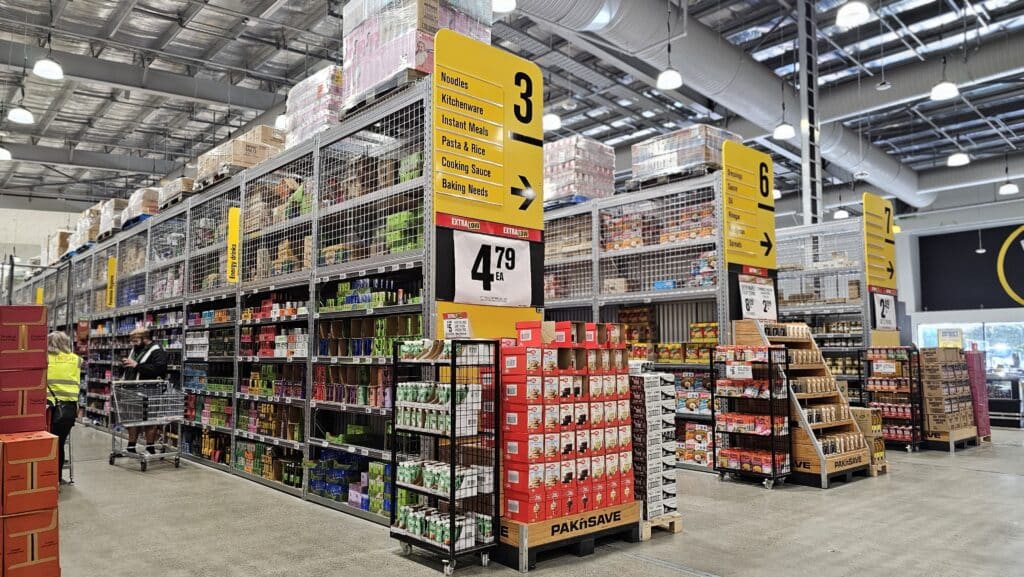
Among the changes to the commercial shelving NZ grocery operators can specify are timber-framed end bays and wire shelves. Volume is also developing customised systems to suit individual store layouts.
Supermarkets look for extra capacity between shelves
In larger supermarkets, increasing the amount of stock a store can carry may depend on relatively small adjustments to individual shelving units.
Some pallet-racking systems now allow beam heights to be set at 25mm intervals rather than the previous 75mm increments, giving retailers more flexibility to position shelves according to product dimensions.
Currie says improvements to the commercial shelving NZ supermarkets use can free up valuable space across thousands of product lines.
“A few centimetres does not sound significant, but multiply that across an entire supermarket and it becomes a considerable amount of usable space.”
Supermarket News reported on Volume’s expansion plans and growing storage infrastructure requirements across New Zealand’s grocery sector.
Larger warehouses create more complex engineering requirements
The growing demands on commercial shelving NZ retailers install extend beyond the shop floor to the distribution network supplying their stores.
Currie says the concentration of stock at central distribution hubs and the growth of online retail are increasing storage requirements at warehouses operated by retailers and third-party logistics providers.
“The consumer may never see those buildings, but changing consumer behaviour is helping drive their growth.”
Warehouse operators are looking upwards for additional capacity rather than relying solely on larger buildings. Taller installations and heavier loads are increasing the engineering requirements for the racking and commercial shelving NZ warehouse operators commission, including consideration of seismic forces and structural capacity.
Volume traces its origins to Shelving Shop, a business established in 1993 to serve the rural sector. It subsequently acquired RMS and Top Shelf before purchasing specialist storage manufacturer Novalok in late 2023.
The Novalok purchase brought domestic manufacturing, engineering and product development expertise into the group, expanding the range of commercial shelving NZ customers can source from Volume. The businesses were integrated over 29 months before adopting the Volume name.
Staff numbers have increased from around nine to more than 20 over three years.
Rather than supplying individual storage systems, the expanded business is taking on projects that cover successive stages of inventory handling, from receiving goods and replenishing stock to distribution and retail display.
Currie says the complexity and scale of these projects will be central to the company’s next phase of expansion.
“We are increasingly looking at the entire movement of inventory through a store or warehouse rather than one isolated part of it, and that is where we see the next stage of growth coming from,” says Currie.
Public relations for commercial storage and infrastructure businesses
Impact PR is an Auckland-based New Zealand public relations agency with experience in manufacturing and infrastructure communications. The agency distributed Volume’s November 2026 announcement to media. Its construction and infrastructure PR services support manufacturers and suppliers seeking to raise their profile with commercial decision-makers. For providers of the commercial shelving NZ businesses depend on, trade and business media coverage can help explain technical capabilities and the economic value of storage investment. Impact PR also provides media training and issues management to help businesses communicate complex industry developments and protect their corporate reputation.