Aviation Engineering Training Launches in Hamilton as Skills Shortage Grows
A new aviation engineering training initiative is being established in Hamilton as New Zealand’s aviation sector confronts a shortage of hundreds of aircraft engineers and rising competition for specialist skills.
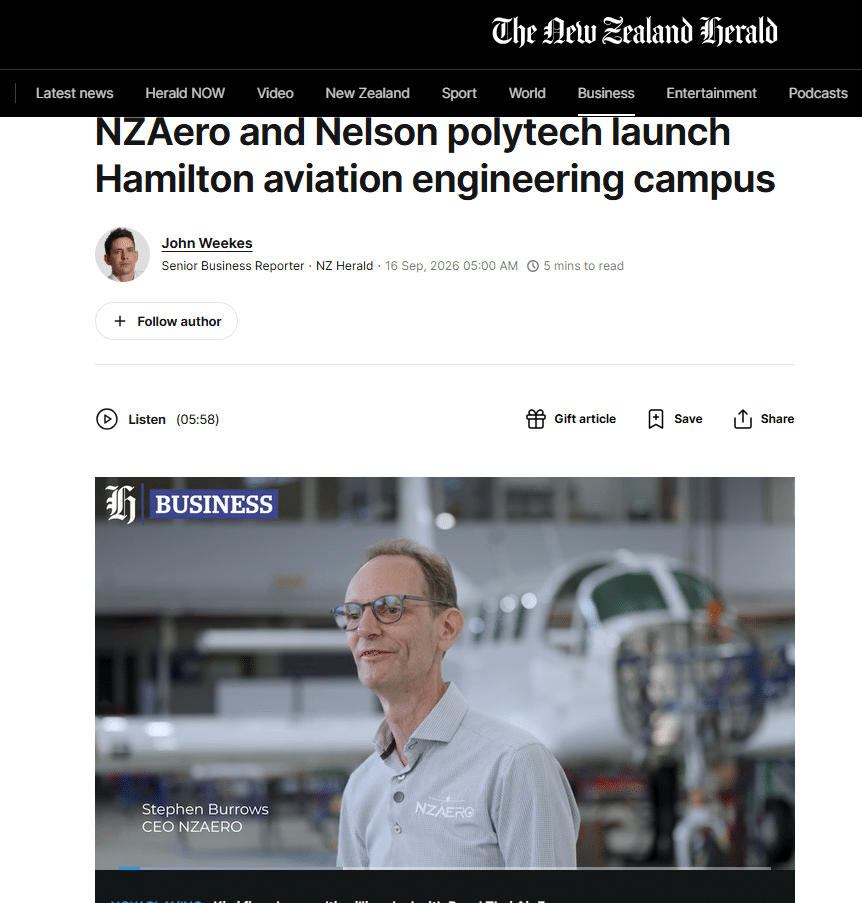
The partnership between NZAero and Nelson Marlborough Institute of Technology (NMIT) will place students inside an operating aircraft manufacturing environment, with the development also attracting coverage from NZ Herald.
The programme will be based at NZAero’s Waikato manufacturing facility and will extend NMIT’s specialist aviation engineering provision into the North Island. Once fully established, the initiative is expected to contribute to the training of up to 230 aviation engineering students each year across New Zealand.
NZAero and NMIT are establishing a new aviation engineering training initiative at NZAero’s Hamilton manufacturing facility.
Aviation engineering training responds to widening workforce gap
Industry workforce projections indicate New Zealand will require about 4,500 aviation engineers by 2034, compared with approximately 3,000 today. That would require engineering capacity to increase by about 50% over the next eight years.
Modelling prepared for the Aviation Industry Association and the former Services Workforce Development Council, Ringa Hora, puts the existing shortfall at around 500 engineers. The gap between supply and demand is estimated to be increasing by an average of 7% annually, while demand for engineers is forecast to rise by around 2% to 3% each year.
The challenge is compounded by workforce turnover. New entrants to aviation engineering are projected to increase by an average of around 1.4% annually, while the number leaving the workforce is expected to grow by about 3% a year.
NMIT chief executive Dr Caroline Seelig says increasing aviation engineering training capacity is important because the sector cannot quickly replace experienced people once shortages become severe.
“We are not bringing people into the industry fast enough to replace those leaving, let alone provide the additional engineers we will need as aviation grows.
“At the same time, every major aviation market is competing for the same people, which means experienced engineers are becoming harder and more expensive to recruit from overseas.
“Aviation engineering is highly specialised and regulated, and it takes years to train people and build the experience needed to maintain, repair and certify aircraft. This isn’t a shortage you can solve quickly once it becomes critical.
“If we don’t increase the number coming through, we are going to see pressure on maintenance capacity, aircraft potentially spending longer out of service and aviation businesses reaching limits on how much work they can take on,” she says.
Hamilton aviation engineering training links students with industry
The new Hamilton programme will operate from NZAero’s site, where the company designs, manufactures, maintains and modifies aircraft for customers in New Zealand and overseas. The aviation engineering training model is intended to give students direct exposure to the equipment, processes and standards used in aircraft production and maintenance.
NMIT has delivered aviation engineering education for more than 20 years and is a Civil Aviation Authority-approved Part 147 training provider. The Civil Aviation Authority’s Part 147 framework covers certification requirements for organisations providing aircraft maintenance training.
For prospective students in the North Island, the initiative creates another location for specialist aviation engineering training alongside NMIT’s established South Island provision.
Hamilton was also identified as a practical alternative to Auckland, with access to nearby centres including Cambridge and Te Awamutu and lower accommodation and transport costs for students.
NZAero chief executive Stephen Burrows says the engineering workforce needed to sustain the aviation sector is often larger than people realise.
“As a broad industry rule of thumb, four engineers are required to support each pilot and the aircraft they operate.
“The workforce we will need later this decade depends on the training decisions being made now and, for companies like NZAero, the shortage is already becoming a direct constraint on growth.
“We are expanding into international markets, but winning export orders is only part of the equation. We also need enough skilled people in New Zealand to build the aircraft and support them once they are in service.”
NZ Herald covered the NZAero and NMIT initiative to expand aviation engineering training in Hamilton.
Aviation engineering training supports export growth
The workforce issue is particularly relevant for manufacturers seeking to increase overseas sales. NZAero has been expanding its international activity from Hamilton, including restarting production of the CT-4 Airtrainer after a 14-year pause and pursuing new aircraft sales in export markets.
Locating aviation engineering training alongside an operating manufacturer also gives NZAero an opportunity to identify people who may later move into factory roles as production grows.
The skills being developed are also used more widely across aircraft manufacturing, maintenance and the broader aviation industry.
Dr Seelig says the Hamilton initiative will also create scope for existing aviation workers to undertake further training and give more North Island learners access to specialist study without having to relocate to the South Island.
PR support for New Zealand aviation and manufacturing businesses
Specialist aviation, aerospace and manufacturing businesses often need to explain complex technical developments in a way that is relevant to customers, investors, government, prospective employees and the wider public.
Strong media relations can help translate workforce investment, export activity and new manufacturing capability into credible business stories.
Impact PR works with companies operating in technical and industrial sectors where accuracy, reputation and subject knowledge are critical. Our corporate PR specialists help businesses develop media angles, executive commentary and communications programmes designed to build awareness with important audiences.
For aviation businesses, this can include communicating export growth, workforce development, manufacturing investment and industry capability. Effective communications can also support recruitment and public understanding as aviation engineering training becomes increasingly important to the sector’s long-term capacity.