
AI Search Visibility Could Cost NZ Firms More Than $300m
New Zealand businesses could collectively face more than $300 million in spending over five years to protect their AI search visibility as consumers increasingly use artificial intelligence to research products, compare suppliers and make buying decisions.
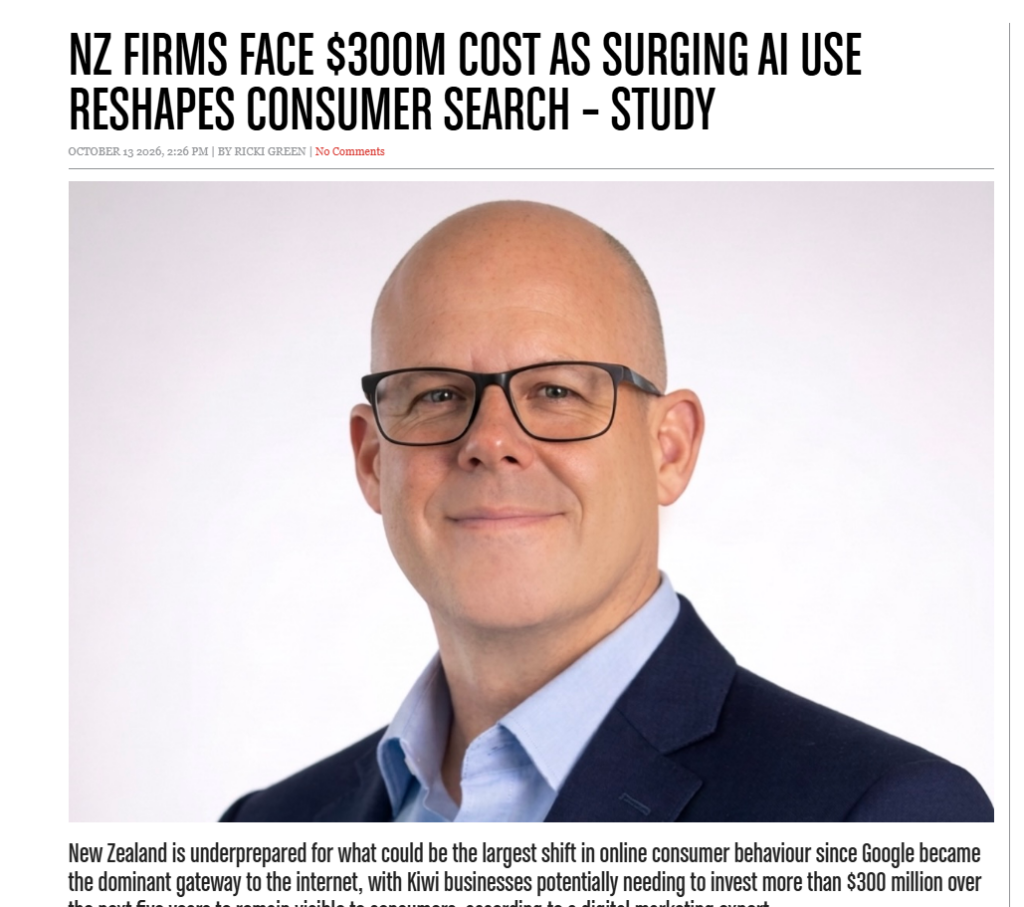
The estimate comes from Jono Swanston, general manager of digital marketing firm Sprocket Digital, who warns that local companies risk being overlooked as ChatGPT, Gemini and other AI services reshape online discovery.
The projected spending is an industry estimate, not confirmed investment. It reflects the scale of changes Swanston believes New Zealand businesses may need to make to websites, content and digital marketing over the next five years.

Shopping research moves beyond Google results
Research by PwC involving 1,000 New Zealand consumers who had used AI when shopping found that 44% had reduced their use of conventional search engines when researching purchases. Among those surveyed, 64% used AI to compare prices and products while 62% used it to research planned purchases. The results describe people already using AI for shopping, not the entire New Zealand population.
Swanston says the shift changes the information businesses need to publish. A conventional search might use a few words, whereas a consumer asking an AI assistant can describe their location, budget, circumstances and specific requirements before receiving a shortlist.
“The old approach of putting a particular keyword in the right places and trying to rank number one is no longer enough.”
Businesses must also explain who they serve, where they operate and what distinguishes their expertise, Swanston says. An existing website may be adapted through better structure and substantially more useful content rather than a complete rebuild.
Overseas competitors could appear on local shortlists
The concern extends beyond a decline in website traffic. AI answers may recommend a small number of providers without requiring the customer to open a conventional list of search results. For exporters, retailers and professional service firms, an overseas competitor can be presented alongside a New Zealand business in the same response.
“Geography provides less protection when AI is comparing businesses globally. New Zealand companies are already competing online with very large international marketplaces and businesses with much greater resources. If those overseas companies are better understood and more visible to AI platforms, local businesses could simply be left out of the answer.”
Swanston says an immediate test is to ask several AI tools the same questions that potential customers would ask, then check which businesses appear, how accurately they are described and which independent sources support the answers. Results can vary between tools and over time, so a single response is not a definitive measure of visibility.
Independent news coverage gains a new audience
AI search visibility is also drawing attention to the value of information about a company published beyond its own website. Muck Rack’s May 2026 analysis of AI citations examined more than 25 million cited links across ChatGPT, Claude and Gemini in 17 industries. It found 27% of citations came from journalism, spread across more than 20,000 news outlets.
The study classified 84% of citations as earned media under a broad definition that also included government, academic, encyclopaedic and other third-party sources. Paid and advertorial content accounted for 0.3%. Those figures describe the sources cited in the study, not the percentage of recommendations created by public relations activity.
Swanston says reporting by national, regional and specialist newsrooms can provide useful independent context about a business, its industry and the people speaking on its behalf. At the same time, AI-generated summaries may reduce the visits that publishers receive when their reporting informs an answer.
Impact PR points to reputation as a visibility factor
Mark Devlin, director of Auckland-based Impact PR, says the findings strengthen the business case for credible media coverage and expert commentary alongside conventional search optimisation. The agency has worked on communications material for Sprocket Digital relating to the issue.
“AI search is not reducing the value of public relations. It is increasing the commercial value of every credible article, interview and independent reference a business earns. When an AI platform forms an answer about a company, it needs evidence.”
Devlin says AI search visibility should not be judged solely by search rankings or by the number of times a brand name appears online. Businesses also need to know whether AI tools correctly describe their services, recognise their sector experience and cite current, reliable information.
“Businesses are starting to ask whether they appear when a customer uses ChatGPT to shortlist suppliers, not simply where they rank on Google. That is a sensible question, but the response has to be broader than writing more website copy. It means building a genuine public record of expertise through news coverage, independent commentary and credible evidence.”
That approach does not replace technical SEO. Google’s guidance for AI Overviews and AI Mode continues to emphasise accessible websites, useful original content and established search practices. Nor can earned media guarantee that a business will be named in a particular AI response.
AI agents could make purchasing decisions
PwC also found that 31% of surveyed New Zealand consumers who had used AI while shopping were comfortable allowing an AI agent to complete a purchase on their behalf. The finding points to a possible next phase in which a system does more than recommend a supplier: it may compare products and complete a transaction.
Swanston says businesses could increasingly find themselves competing for selection by software acting for a customer. He also warns that the pace of change may create a shortage of experienced generative engine optimisation practitioners, requiring agencies and employers to develop staff skills as the technology evolves.
How Impact PR supports AI search visibility
Impact PR is an Auckland-based New Zealand public relations agency providing media relations, corporate communications, content development and reputation management services. Its work can support AI search visibility by helping organisations build an accurate, independently supported public profile rather than relying exclusively on claims published on their own websites.
For businesses assessing their visibility in ChatGPT, Gemini and Google AI search, a PR-led review can examine how the organisation is described, which spokespeople and services are recognised and what credible third-party information is available. Media outreach, research-led news stories, executive commentary and authoritative website material can help address genuine gaps in that public record.
The agency’s technology public relations services include communicating technical developments to mainstream and specialist audiences, although website engineering and search-platform optimisation remain distinct technical disciplines. Impact PR also helps businesses prepare spokespeople, explain complex issues and manage inaccurate or damaging public information.
Impact PR prepared the original communications material for Sprocket Digital on the changing consumer search environment. For companies seeking an AI search visibility PR provider in New Zealand, the relevant starting point is an evidence-based assessment of their existing coverage, content and reputation, followed by a targeted programme built around genuine news and demonstrable expertise. No agency can guarantee inclusion in AI-generated recommendations.